But what if your security team could train against a dummy version of the enemy beforehand? That is exactly how vaccines work. They are the ultimate training camp for your immune system, teaching your body how to win the fight before the real battle even begins.
The Training Ground: How Vaccines Actually Work
To understand how vaccines work, you have to look at how your body fights disease naturally. When a germ enters your body, it carries tiny, unique markers on its outer shell. Scientists call these markers antigens (College of Physicians of Philadelphia, 2024).
Your immune system’s job is to spot these foreign antigens and create special, custom-shaped proteins called antibodies to lock onto them and destroy them.
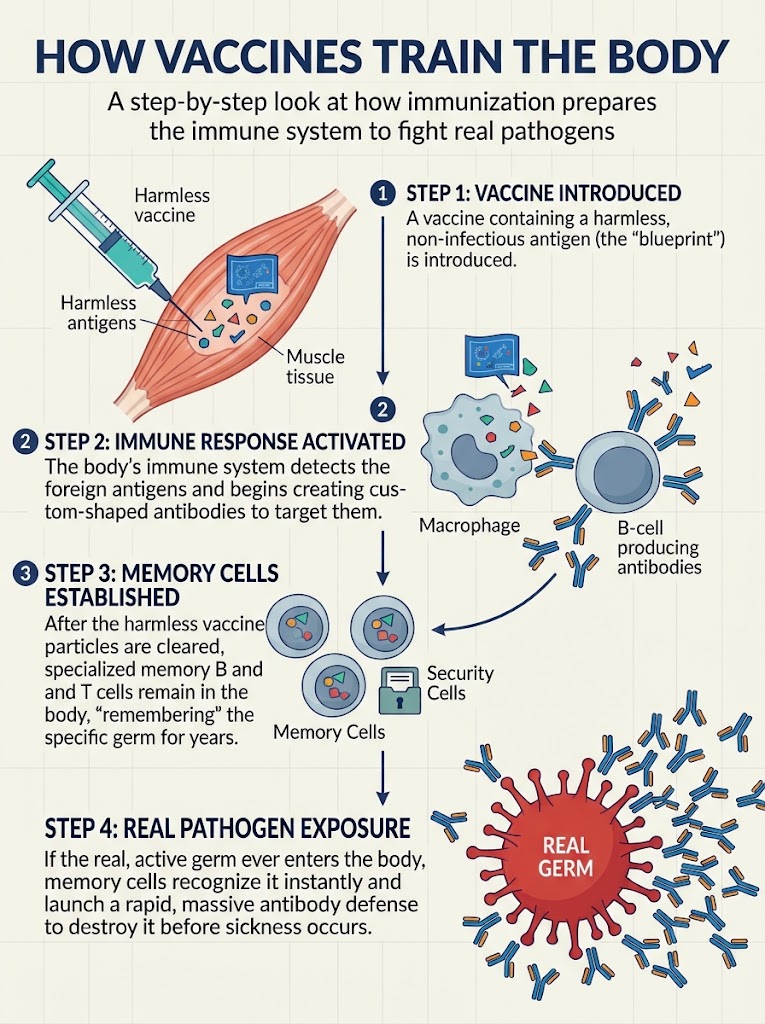
Creating these custom antibodies from scratch is a slow process. Once your body successfully defeats a germ, it creates "memory cells." These cells remember the specific enemy for years. If that germ ever dares to show up again, the memory cells immediately unleash a massive, rapid-response army of antibodies, wiping out the threat before you even feel a sniffle. This fast, permanent defense is called immunity.
Vaccines bypass the danger of getting sick by introducing a harmless, mock version of the germ to your immune system. Because the vaccine contains the germ's unique antigens—but is designed so it cannot reproduce or cause harm—your immune system goes to work. It studies the invader, develops custom antibodies, and creates memory cells.
When you get vaccinated, you get all of the life-saving memory cells and antibodies without having to suffer through the actual disease.
There are several ways scientists build these "training dummies":
- Weakened (Attenuated) Vaccines: These use a live but extremely weak version of the virus. Examples include the MMR (measles, mumps, and rubella) vaccine.
- Killed (Inactivated) Vaccines: These use germ particles that have been completely destroyed, such as the polio vaccine.
- Subunit or Conjugate Vaccines: These include only the most recognizable pieces of the germ—like a protein from its outer shell. The influenza (flu) shot and HPV vaccines use this method.
- mRNA Vaccines: The newest technology, used in COVID-19 vaccines, does not even contain a piece of the germ. Instead, it delivers a temporary genetic "blueprint" (messenger RNA) that tells your own cells to temporarily make a harmless spike protein that looks like the virus. Your immune system spots this new protein, goes on the attack, and trains itself for the real thing. Once the training is done, your body naturally destroys the mRNA blueprint (Johns Hopkins, 2026).
From Cowpox to COVID-19: A Quick History
Long before scientists understood antibodies, humans were desperately trying to protect themselves from deadly outbreaks. For centuries, the most feared disease was smallpox, which killed about 30% of those it infected and left survivors scarred or blind (CDC, 2024).
Early physicians in China, India, and the Ottoman Empire practiced "variolation"—rubbing scabs or fluid from smallpox sores into the skin of healthy people (World Health Organization, 2025). This was risky and often caused full-blown, deadly infections, but it was the earliest attempt to provoke immunity.
In 1796, an English doctor named Edward Jenner made a breakthrough. He noticed that milkmaids—women who milked cows—rarely got smallpox. However, they frequently caught "cowpox," a mild illness that caused harmless sores on their hands.
Jenner guessed that catching cowpox protected people from smallpox. He took fluid from a milkmaid's cowpox sore and scratched it into the arm of a young boy. After the boy recovered from a brief, mild bout of cowpox, Jenner exposed him to actual smallpox. The boy remained perfectly healthy.
Because Jenner used cowpox—scientific name vaccinia—the process became known as "vaccination" (Mayo Clinic, 2025). Over the next two centuries, Jenner’s basic concept was refined, eventually leading to a global vaccination campaign that completely eradicated smallpox from the face of the Earth in 1980 (WHO, 2025).
In the mid-20th century, scientists like Jonas Salk and Albert Sabin developed polio vaccines, which saved millions of children from paralysis. Later, vaccines for measles, mumps, and rubella transformed once-deadly childhood infections into rare events.
By the time COVID-19 emerged, scientists were ready to deploy a technology they had been developing for decades: mRNA. Traditional vaccine development took years because it required growing enormous quantities of weakened or killed viruses in labs. mRNA vaccines, however, are made chemically, allowing them to be developed and manufactured in just months (Johns Hopkins, 2026).
The Math of Herd Immunity
Vaccines do not just protect the person who gets the shot; they can protect entire communities. When enough people in a population are immune to a disease, it cannot find new hosts, and the spread slows to a halt. This community-wide shield is called herd immunity (History of Vaccines, 2025).
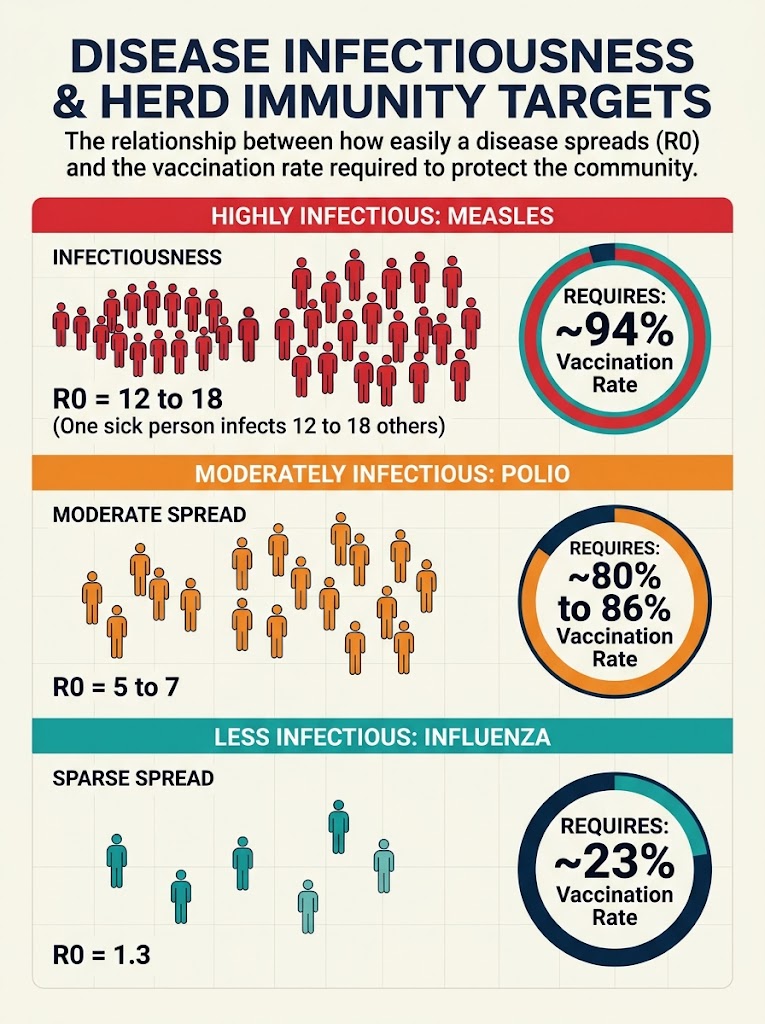
To calculate how many people need to be vaccinated to achieve herd immunity, epidemiologists use a mathematical value called R0 (pronounced "R-nought"), or the basic reproduction number (University of Michigan, 2020). R0 represents the average number of people one infected person will pass the disease to in a fully susceptible population.
To find the percentage of the population that must be immune to stop an outbreak, scientists use a simple formula (History of Vaccines, 2025):
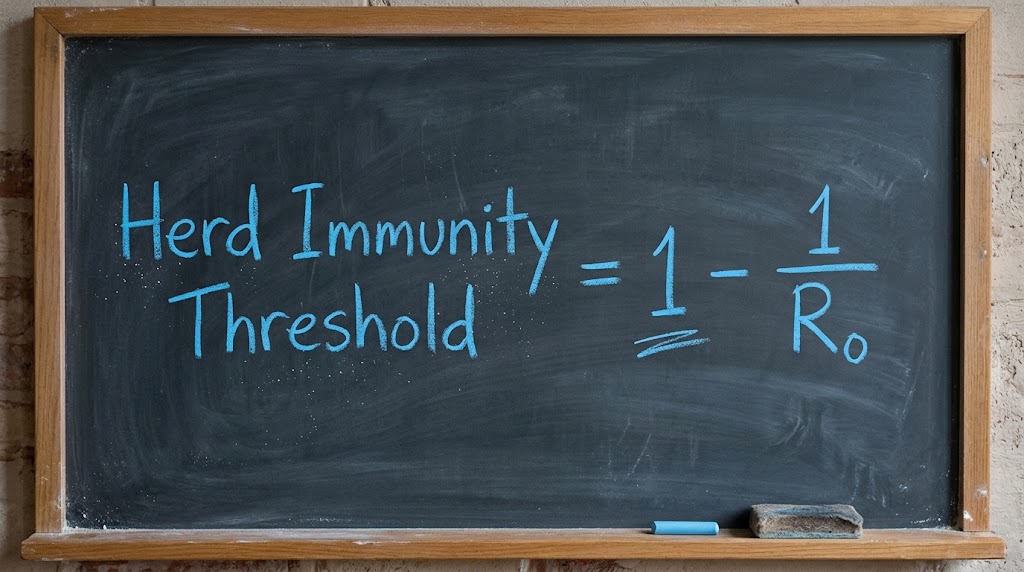
Let’s look at some real-world math:
- Polio has an R0 of about 5. One sick person usually infects five others. Applying the formula:

To stop polio, at least 80% of the population must be immune.
- Measles is incredibly infectious, with an R0 of 12 to 18. Applying the formula for an R0 of 18:

Because measles is so contagious, a community needs a vaccination rate of 94% to 95% to prevent outbreaks. If the vaccination rate drops even slightly below this target, measles can quickly make a comeback.
This math is critical because some people in our communities cannot get vaccinated—such as newborn babies, cancer patients undergoing chemotherapy, or individuals with severe allergies. These vulnerable people rely on the healthy members of the community to get vaccinated and act as a human shield.
Separating Vaccine Facts from Rumors
Like any medication, vaccines are heavily studied, but they have also been the subject of fear, rumors, and misinformation. Let’s look at some common concerns and see how they match up against scientific reality:
Safety and Side Effects
- The Rumor: Vaccines are unsafe and can cause long-term health problems like autism.
- The Science: The idea that the MMR vaccine causes autism comes from a single 1998 study by a doctor named Andrew Wakefield. Later, it was discovered that he had falsified his data, and the journal officially retracted the paper. Dozens of massive, independent, global studies involving millions of children have proved there is absolutely no link between vaccines and autism (Mayo Clinic, 2025).
- The Reality: Vaccines can cause mild, temporary side effects, such as a sore arm, low fever, or fatigue. These are actually good signs—they show that your immune system's "security force" is actively practicing and building defenses. Severe reactions, like a dangerous allergic response, are incredibly rare, occurring in about one in a million doses.
Speed of Development
- The Rumor: The COVID-19 mRNA vaccines were rushed and are unsafe because they were made too fast.
- The Science: While the vaccines were developed quickly, no safety steps were skipped. The fast timeline was possible because researchers had spent over 30 years developing mRNA technology, governments around the world poured billions of dollars into the effort, and thousands of volunteers eagerly signed up for clinical trials (Johns Hopkins, 2026).
The Big Debate: Should Vaccines Be Mandated?
Since the 1800s, when Massachusetts became the first state to require the smallpox vaccine for schoolchildren, people have debated whether the government should mandate vaccines for healthy individuals (Mayo Clinic, 2025).
The "Pro-Mandate" Perspective (For Requirements)
Supporters of vaccine mandates, especially for highly infectious diseases like measles, polio, and COVID-19, argue that public health must come first (Britannica, 2026).
- Community Protection: If people choose not to vaccinate, herd immunity crumbles, putting vulnerable infants and immunocompromised individuals at risk.
- Economic and Social Benefits: Eradicating or controlling diseases through high vaccination rates keeps schools open, protects the economy, and saves billions of dollars in healthcare costs.
- Historical Success: Mandates are the reason polio was eliminated from the United States and why we no longer worry about smallpox.
The "Anti-Mandate" Perspective (Against Requirements)
Opponents of vaccine mandates argue that forcing individuals to get a medical procedure is an overreach of government power (Britannica, 2026).
- Personal Freedom: Critics believe that people should have bodily autonomy—the right to make their own choices about what goes into their bodies.
- Distrust and Backlash: Forcing people to get vaccinated can create resentment, making them lose trust in doctors, scientists, and the government (BMJ Global Health, 2022).
- Individual Risk vs. Benefit: Critics argue that because every medical treatment carries some risk, individuals should weigh those risks for themselves.
In many places, a middle-ground approach is used. Instead of universal mandates, schools and healthcare facilities require vaccination, but offer exemptions for medical reasons, religious beliefs, or personal objections (CDC, 2024).
What’s Next for Vaccines?
The vaccine industry is moving fast, with mRNA technology at the forefront (ResearchAndMarkets, 2024).
- One-Shot Combos: Scientists are working on combination vaccines, like a single annual shot that protects against the flu, COVID-19, and RSV (Moderna, 2026).
- Cancer Vaccines: Personalized mRNA vaccines are being developed to train the immune system to recognize and destroy specific cancer cells in patients (Merck/Moderna, 2026).
- Tackling Ancient Foes: Researchers are using new technologies to design vaccines for malaria, HIV, and tuberculosis—diseases that have evaded standard approaches for generations (CAS, 2025).
Conclusion
Vaccines are one of the greatest achievements in human history. They have saved hundreds of millions of lives, eradicated smallpox, and given us a powerful tool to fight new global threats like COVID-19. By understanding how they train our bodies, the math of herd immunity, and the true safety data, we can make informed decisions to protect ourselves, our families, and our communities.
Bibliography
CAS. (2025). The Future of mRNA Vaccines Beyond COVID-19. CAS, a division of the American Chemical Society. https://www.cas.org/resources/white-papers/future-mrna-vaccines
Centers for Disease Control and Prevention (CDC). (2024). History of Smallpox. CDC Global Health. https://www.cdc.gov/smallpox/history/history-of-smallpox.html
College of Physicians of Philadelphia. (2024). How Vaccines Work. The History of Vaccines. https://www.historyofvaccines.org/content/how-vaccines-work
Encyclopaedia Britannica. (2026). Employer and School Vaccine Mandates: Pros, Cons, and the Ongoing Debate. Britannica Insights. https://www.britannica.com/story/vaccine-mandates-history-arguments
Johns Hopkins Bloomberg School of Public Health. (2026). Understanding mRNA Vaccines: Progress, Safety, and Global Scale. JHU Media Briefing Transcript. https://publichealth.jhu.edu/2026/mrna-vaccines-how-they-work
Mayo Clinic. (2025). History of Disease Outbreaks and the Evolution of Vaccine Timelines. Mayo Clinic Patient Education. https://www.mayoclinic.org/disease-outbreaks-vaccine-timeline
Moderna Inc. (2026). Developing Next-Generation mRNA Combination Vaccines for Respiratory Viruses. Moderna Research & Development. https://www.modernatx.com/pipeline
ResearchAndMarkets. (2024). Global mRNA Vaccine and Therapeutics Market Outlook to 2030. Research and Markets Report. https://www.researchandmarkets.com/reports/mrna-platform-2024
The Lancet. (2022). The Unintended Consequences of COVID-19 Vaccine Policy. BMJ Global Health. https://gh.bmj.com/content/7/5/e008684
University of Michigan School of Public Health. (2020). Activity: What are R0 and Herd Immunity? https://sph.umich.edu/covid/activity-r0-herd-immunity.html
World Health Organization (WHO). (2025). A Brief History of Vaccination: From Jenner to Global Eradication. WHO Spotlights. https://www.who.int/news-room/spotlight/history-of-vaccination

Comments
No published comments yet. Start the conversation.