When people talk about gun violence, the first images that usually come to mind are mass shootings or street crime. Television news and movies focus heavily on homicides. Because of this, many people believe that homicides make up the largest share of gun-related deaths. However, public health records tell a very different story. In the United States, the majority of people who die from a gunshot wound do not die from an attack by someone else. They die by suicide.
Understanding how firearm laws influence suicide rates requires looking at what scientists call "means restriction." This concept explores whether making a highly lethal tool harder to get saves lives, or whether a suicidal person simply finds another way to die. By looking at real-world data and peer-reviewed studies, we can evaluate whether gun control effectively lowers the total number of suicides and see what steps lawmakers can take to protect vulnerable people.
Suicide: The Overlooked Majority of Gun Deaths
According to mortality data from the Centers for Disease Control and Prevention (CDC), suicide is consistently the single largest category of firearm deaths in the United States. In recent years, approximately six out of every ten gun deaths—roughly 55% to 60%—have been suicides, while homicides account for most of the remainder. In 2024, for example, more than 27,000 Americans died by firearm suicide, compared to about 15,000 firearm homicides.
Firearms also play a central role in overall suicide statistics. Although guns are used in fewer than 5% of all suicide attempts, they account for more than half of all completed suicide deaths. This stark contrast comes down to a simple, tragic reality: lethality. Studies show that approximately 85% to 90% of suicide attempts involving a firearm end in death. By comparison, drug overdoses—which represent the most common method of suicide attempt—have a case fatality rate under 5%. Because firearms are exceptionally lethal, easy to operate, and irreversible once used, having quick access to a gun turns a momentary crisis into a permanent tragedy.
The Nature of Suicidal Crises: Why Time Matters
A common myth about suicide is that it is always the result of months of careful planning. While some people struggle with depression and suicidal thoughts for a long time, the actual decision to act is often impulsive.
Psychiatric research shows that many suicide attempts occur during an acute emotional crisis, such as a painful breakup, job loss, or sudden legal trouble. In many cases, the window of time between a person deciding to end their life and taking action is less than one hour, and sometimes just a few minutes.
Furthermore, suicide is rarely inevitable. Long-term studies tracking individuals who survive serious suicide attempts reveal that approximately 90% never go on to die by suicide later in life. They receive help, life circumstances change, and the crisis passes. Because the crisis is usually short-lived and non-recurring, any barrier that slows a person down or forces a delay can be lifesaving. This principle is known as means restriction: removing or delaying access to highly lethal tools until the acute danger subsides.
Gun Control and Suicides: Method Substitution vs. Total Reduction
A central scientific question is whether gun control actually reduces total suicides, or whether it simply causes "method substitution." The method substitution hypothesis suggests that if a person cannot get a gun, they will simply use another lethal method, leaving the overall death toll unchanged.
Epidemiological research across states and countries has tested this hypothesis extensively. The evidence indicates that when access to firearms is restricted, the total number of suicides decreases, because alternative methods are far less likely to be fatal (Pollock, 2019).
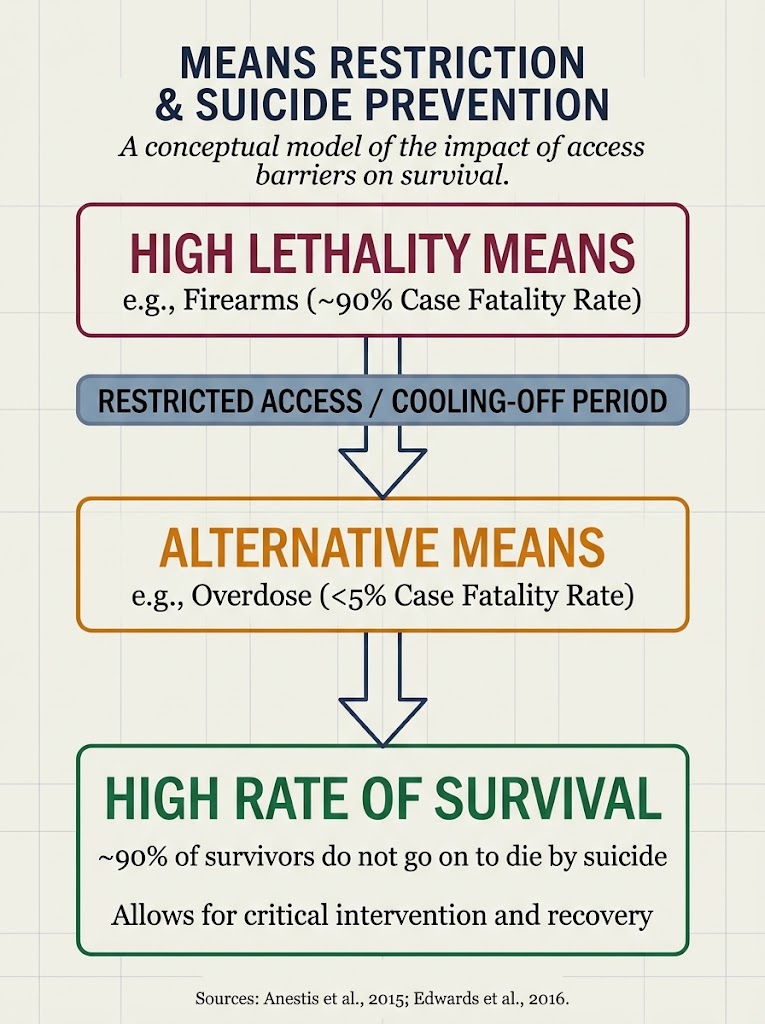
Peer-reviewed literature demonstrates that states with higher rates of gun ownership have significantly higher rates of overall suicide—not just firearm suicide—even after adjusting for differences in poverty, mental illness rates, and substance abuse (RAND Corporation, 2018). While people denied immediate firearm access may occasionally substitute another method, that alternative is far more survivable. Because survivors usually do not attempt suicide again, restricting firearms prevents suicide overall rather than merely changing the weapon used.
What the Peer-Reviewed Research Shows
Multiple peer-reviewed studies have examined how specific firearm policies influence suicide mortality:
1. Mandatory Waiting Periods
A waiting period creates a legally mandated delay between purchasing a firearm and taking physical possession of it (typically 3 to 14 days). This acts as a cooling-off period for individuals acting on sudden suicidal impulses.
- A study published by Griffin Sims Edwards and colleagues found that statutory delays between firearm purchase and delivery led to significant reductions in firearm suicides without causing an increase in non-firearm suicides (Edwards et al., 2016).
- An analysis by Stephen Oliphant in Injury Prevention evaluated Wisconsin's repeal of its two-day handgun waiting period. The study demonstrated that eliminating the waiting period led to a measurable increase in both handgun and overall firearm suicide rates (Oliphant, 2022).
2. Permit-to-Purchase and Licensing Laws
Permit-to-purchase (PTP) laws require individuals to pass a background check and obtain a permit from local law enforcement before buying a handgun.
- Michael Anestis and Joye Anestis examined state-level gun policies in the American Journal of Public Health and reported that states with comprehensive firearm regulations, including permit requirements and waiting periods, saw significantly lower overall suicide rates compared to states with minimal restrictions (Anestis & Anestis, 2015).
- Further work by Anestis et al. confirmed that states with permit laws saw decreases in total suicide rates that were not offset by increases in other methods (Anestis et al., 2015).
3. Safe Storage Laws and Child Access Prevention (CAP)
Many adolescent suicides involve firearms owned by parents or relatives. Child Access Prevention laws require firearm owners to store guns locked and unloaded whenever minors are present. Reviews conducted by the RAND Corporation found evidence that CAP laws significantly reduce both accidental shootings and firearm suicides among youth.
Concrete Steps for Lawmakers
Based on empirical public health data, lawmakers can pursue targeted, evidence-based policies designed specifically to prevent suicides without burdening responsible long-term firearm ownership:
1. Enact Mandatory Waiting Periods: Implementing a mandatory cooling-off period of 3 to 7 days on all firearm purchases creates time for suicidal impulses to fade, preventing spontaneous purchases during acute distress.
2. Pass Extreme Risk Protection Orders (ERPOs): Known as "red flag" laws, ERPOs allow family members or law enforcement to petition a civil court to temporarily remove firearms from individuals showing clear signs of being an immediate danger to themselves or others. Research shows that ERPOs are predominantly used to prevent self-harm, saving roughly one life for every ten to twenty orders issued.
3. Mandate and Incentivize Secure Firearm Storage: Expanding Child Access Prevention laws to hold gun owners accountable for unsecured firearms reduces teen suicide. Lawmakers can pair these mandates with positive incentives, such as exempting gun safes, trigger locks, and lockboxes from sales tax or providing free locking devices at community centers.
4. Support Voluntary "Do Not Sell" Lists: Lawmakers can create confidential registries (often called Donna's Law) that allow individuals who recognize their own struggle with severe depression to voluntarily place themselves on a background-check registry that temporarily blocks them from purchasing a firearm.
5. Fund Means Restriction Public Awareness Campaigns: Public health agencies and firearm safety instructors can collaborate to educate gun owners on the importance of off-site temporary storage during times of family crisis, treating gun suicide as a shared public health challenge.
Conclusion
The scientific evidence is consistent: gun control policies that delay or limit immediate access to firearms are among the most effective public health interventions for reducing suicide. Because suicidal crises are frequently brief and guns carry an exceptionally high fatality rate, barriers that insert time and distance between an individual and a loaded gun save lives. Rather than merely shifting individuals to other methods, effective gun safety regulations reduce the total number of suicides, giving people the second chance they need to heal.
References
Anestis, M. D., & Anestis, J. C. (2015). Suicide Rates and State Laws Regulating Access and Exposure to Handguns. American Journal of Public Health, 105(10), 2049–2058. https://doi.org/10.2105/ajph.2015.302753
Cited by: 205
Anestis, M. D., Khazem, L. R., Law, K. C., Houtsma, C., LeTard, R., Moberg, F., & Martin, R. (2015). The Association Between State Laws Regulating Handgun Ownership and Statewide Suicide Rates. American Journal of Public Health, 105(10), 2059–2067. https://doi.org/10.2105/ajph.2014.302465
Cited by: 104
Edwards, G. S., Nesson, E., Robinson, J. J., & Vars, F. E. (2016). Looking Down the Barrel of a Loaded Gun: The Effect of Mandatory Handgun Purchase Delays on Homicide and Suicide. SSRN Electronic Journal. https://doi.org/10.2139/ssrn.2629397
Cited by: 84
Oliphant, S. N. (2022). Effects of Wisconsin’s handgun waiting period repeal on suicide rates. Injury Prevention, 28(6), 580–584. https://doi.org/10.1136/ip-2022-044719
Cited by: 11
Pollock, N. J. (2019). Place, the Built Environment, and Means Restriction in Suicide Prevention. International Journal of Environmental Research and Public Health, 16(22), 4389. https://doi.org/10.3390/ijerph16224389
Cited by: 24


Comments
No published comments yet. Start the conversation.