When a factory closes its doors, a construction crew changes its workers, or a local business hires foreign-born workers, an old and familiar fear usually rises to the surface: "Are immigrants stealing our jobs?"
It is an understandable concern. If you look at jobs like slices of a single pie, it seems obvious that giving one slice to a newcomer means there is less food left on the plate for everyone else. If an immigrant gets a job, does that mean an American worker goes without one?
Economists have spent decades studying this exact question. What they have found across hundreds of studies is that the economy is not a fixed pie. Instead, it is more like an oven that bakes new pies as more people enter the kitchen. When new people arrive and work, they buy groceries, rent homes, and pay for services, which creates even more jobs for others.
To answer whether immigrants take jobs, we have to look closely at the facts. We must understand how labor markets work, look at the differences between legal and undocumented workers, examine whether open jobs would ever be filled without foreign-born help, and explore how immigrants start new businesses. Finally, we will compare two completely different futures for the American economy to see what our policy choices would actually do to American workers.
1. The Lump of Labor Fallacy and Job Complementarity
The belief that immigrants take jobs away from native-born citizens is based on a famous mistake called the "lump of labor fallacy." This is the incorrect idea that there is only a fixed amount of work to be done in an economy. If that idea were true, then any increase in the population—whether from immigration or simply from people having babies—would cause massive unemployment.
In reality, immigrants do not just supply labor; they also consume goods and services:
- The Supply Side: Immigrants offer their time, energy, and skills to employers who need work done.
- The Demand Side: Immigrants need food, clothes, apartments, cellular phones, cars, haircuts, and doctor visits. Every dollar they spend becomes income for a local grocery store, mechanic, or landlord. Those businesses then hire more staff to handle the extra demand.
Beyond spending money, immigrants rarely compete directly for the exact same jobs as native-born workers. Economists call this complementarity. In simple terms, this means immigrant workers and native-born workers have different skills that work together like puzzle pieces, rather than knocking each other out of the way.
Unauthorized Immigrants
Undocumented workers make up about 4 to 5 percent of the total American workforce. Because many do not speak fluent English and lack formal legal papers, they are concentrated in physical, manual occupations. They work in agriculture, residential construction, dishwashing, commercial cleaning, meatpacking, and landscaping. Most native-born Americans have at least a high school diploma and gravitate toward jobs that require English fluency, customer service skills, computer literacy, or state licenses.
Legal Immigrants
Legal immigrants come through several pathways, including family sponsorship, refugee programs, and skilled work visas like the H-1B program. Skilled legal immigrants frequently work in science, technology, engineering, and mathematics (STEM fields), as well as healthcare. When a hospital hires a foreign-born doctor, or a software company hires a specialized computer engineer, that business can expand its services. That growth creates downstream jobs for native-born nurses, office managers, marketing specialists, and administrative assistants.
2. Would These Jobs Be Filled Without Immigrants?
A common question is: "If employers simply raised their pay, wouldn't native-born Americans take those jobs?"
While higher pay can attract workers in some fields, real-world experiments show that native-born workers almost never step into low-skill, physically punishing roles in large numbers, even when wages go up.
Agriculture provides the clearest proof. Harvesting crops requires intense manual labor under extreme heat, working on your knees or bent over for ten to twelve hours a day, and moving from farm to farm as seasons change. During the early 2010s, states like Georgia and Alabama passed aggressive laws designed to push unauthorized immigrants out of their borders.
The results were immediate and costly:
- Immigrant farmworkers left the states in large numbers.
- Farms faced massive labor shortages and advertised positions with higher hourly pay to native-born workers.
- Very few native-born workers applied. Those who were hired often quit within a single day or two because the work was physically grueling.
- Millions of dollars worth of tomatoes, blueberries, watermelons, and onions rotted on the vine because there was no one to pick them.
- Farmers had to shut down acreage, downsize their operations, or invest millions of dollars in automated picking machines.
When an employer cannot find workers for entry-level tasks, the entire business slows down. Consider a home construction company:
- If the builder cannot find roofers, framers, or drywallers, the house cannot be built.
- Because the house is not built, the company does not hire native-born architects, site managers, heavy machinery operators, building inspectors, or real estate agents.
- Immigrant labor at the base of the economy supports and protects high-paying jobs for native-born workers at the top.
3. Immigrants as Job Creators: The Power of Entrepreneurship
Immigrants are not just workers seeking a paycheck. They are also among the most active business owners in the United States.
A major study by researchers at MIT, Northwestern University, and the Wharton School examined millions of American businesses. They discovered that foreign-born residents are 80 percent more likely to start a company than native-born citizens. While immigrants make up about 15 percent of the total population, they create a disproportionately large share of American businesses.
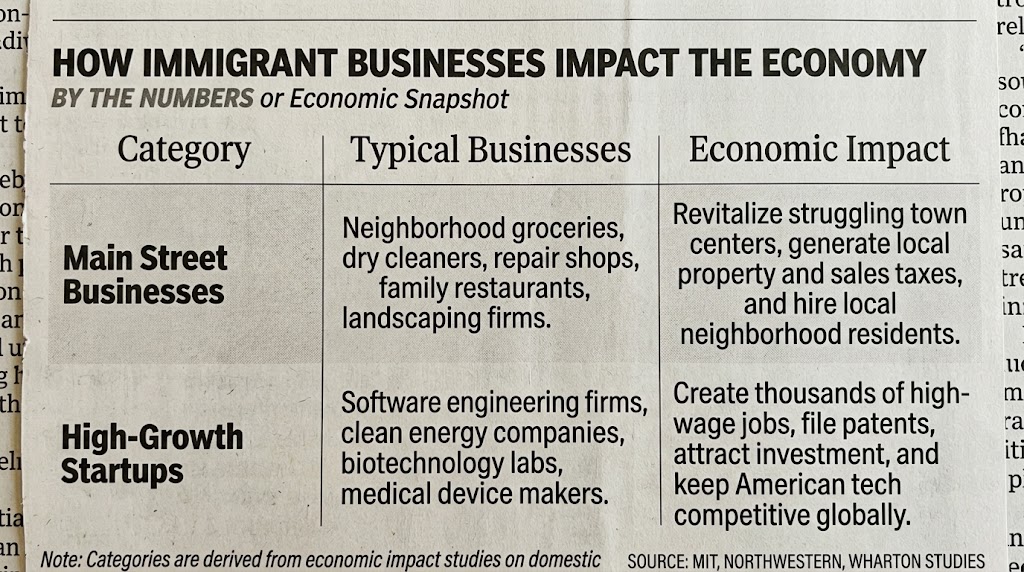
Immigrants have founded or co-founded over 40 percent of the companies on the Fortune 500 list, including iconic companies like Google, Tesla, eBay, and Pfizer. In addition, foreign-born inventors account for roughly one out of every four commercial patents filed in the United States.
By starting businesses, immigrants create payrolls that employ millions of American citizens every single day. They are not taking jobs; they are making jobs.
4. Comparing Two Worlds
To understand how immigration policy affects everyday Americans, we can compare two different policy choices.
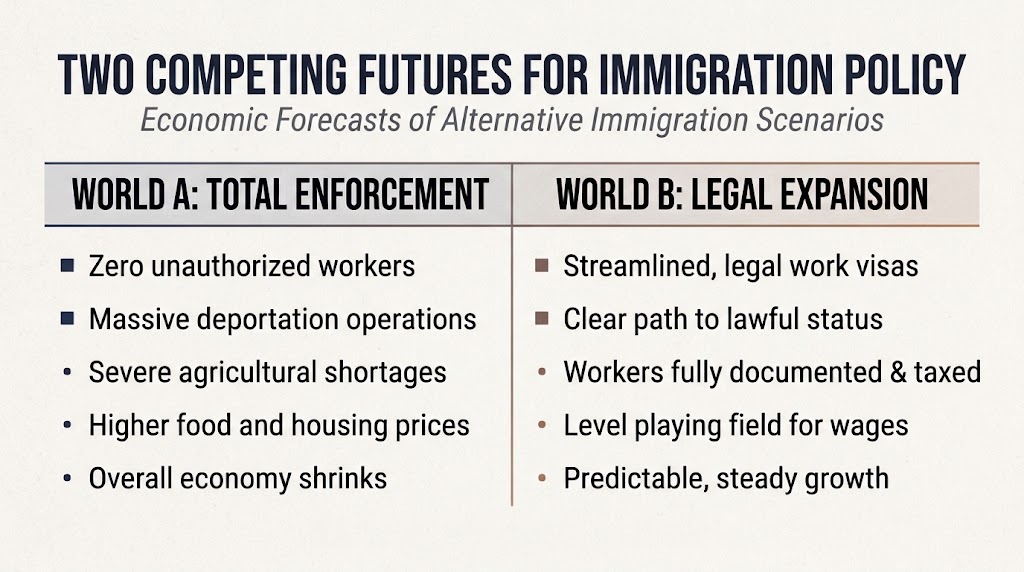
World A: Total Enforcement and Full Border Shutdown
In World A, Immigration and Customs Enforcement (ICE) successfully prevents all undocumented immigration and deports all unauthorized workers. Only native-born citizens and the small number of people already approved through current, slow legal channels remain.
- Immediate Labor Collapse: Core industries like agriculture, meatpacking, homebuilding, and hospitality suddenly lose 7 to 8 million workers. Farms are abandoned, restaurants cut seating, and home construction falls sharply.
- Higher Living Costs: Because it costs far more to find scarce workers, the prices of basic goods skyrocket. Families pay significantly more for groceries, infant childcare, elder care, and new homes.
- Layoffs for Native Workers: Construction companies unable to hire framing crews must cancel housing developments, leading to layoffs for native-born managers, electricians, and engineers.
- Lost Public Revenue: State and local governments lose billions of dollars in sales and property taxes that undocumented immigrants currently pay, forcing cities to cut funding for schools, fire departments, and roads.
World B: Expanded Legal Avenues and Efficient Pathways
In World B, Congress updates America's immigration system. Work visas are expanded to match real market demand for both high-skilled and lower-skilled jobs. Undocumented workers already living here can earn lawful status, pay a fine, and work openly. Legal channels become fast and fair, making illegal border crossings pointless for all except criminals.
- Fair Wages and Safe Workplaces: Employers can no longer pay undocumented workers under the table or ignore safety rules. Because every worker can report labor violations without fear of deportation, bad bosses cannot undercut wages. This protects pay and conditions for native-born workers.
- Economic Stability: Farmers and builders can plan years in advance, knowing they have a dependable, lawful workforce. Construction ramps up, helping bring down the cost of housing for young families.
- Increased Tax Revenues: Workers who once operated in the cash economy now pay full payroll and income taxes. This injects hundreds of billions of dollars into Social Security and Medicare, helping keep safety nets solvent for aging Americans.
- Stronger Innovation: Talented graduates from American universities can start their companies directly in the United States rather than moving abroad, keeping groundbreaking technologies and new jobs at home.
Conclusion
Do immigrants steal our jobs? The clear economic answer is no.
The idea that there is a set number of jobs in a country is an economic myth. Immigrants do not simply take jobs; they fill critical labor shortages that keep entire industries alive, they buy goods and services that keep local stores open, and they launch businesses that employ millions of American workers.
Shutting down immigration shrinks the economy, drives up living costs, and hurts native-born workers by cutting off the base of the economic ladder. In contrast, opening reliable, legal, and orderly avenues for foreign-born workers strengthens wages, increases tax revenue, and expands economic opportunity for everyone.
Bibliography
- Azoulay, Pierre, Benjamin F. Jones, J. Daniel Kim, and Javier Miranda. "Immigration and Entrepreneurship in the United States." American Economic Review: Insights, vol. 4, no. 1, 2022, pp. 71–88.
- Borjas, George J. We Wanted Workers: Unraveling the Immigration Narrative. W. W. Norton & Company, 2016.
- Clemens, Michael A. "The Effect of Foreign Labor on Domestic Employment: Evidence from Seasonal Farm Workers." Center for Global Development Working Paper, no. 488, 2018.
- Hanson, Gordon H. "The Economics and Policy of Illegal Immigration in the United States." Migration Policy Institute, 2009.
- National Academies of Sciences, Engineering, and Medicine. The Economic and Fiscal Consequences of Immigration. The National Academies Press, 2017.
- Peri, Giovanni. "The Effect of Immigration on Productivity: Evidence from U.S. States." The Review of Economics and Statistics, vol. 94, no. 1, 2012, pp. 348–358.


Comments
No published comments yet. Start the conversation.